Saturday, April 19, 2014


Saturday, March 8, 2014
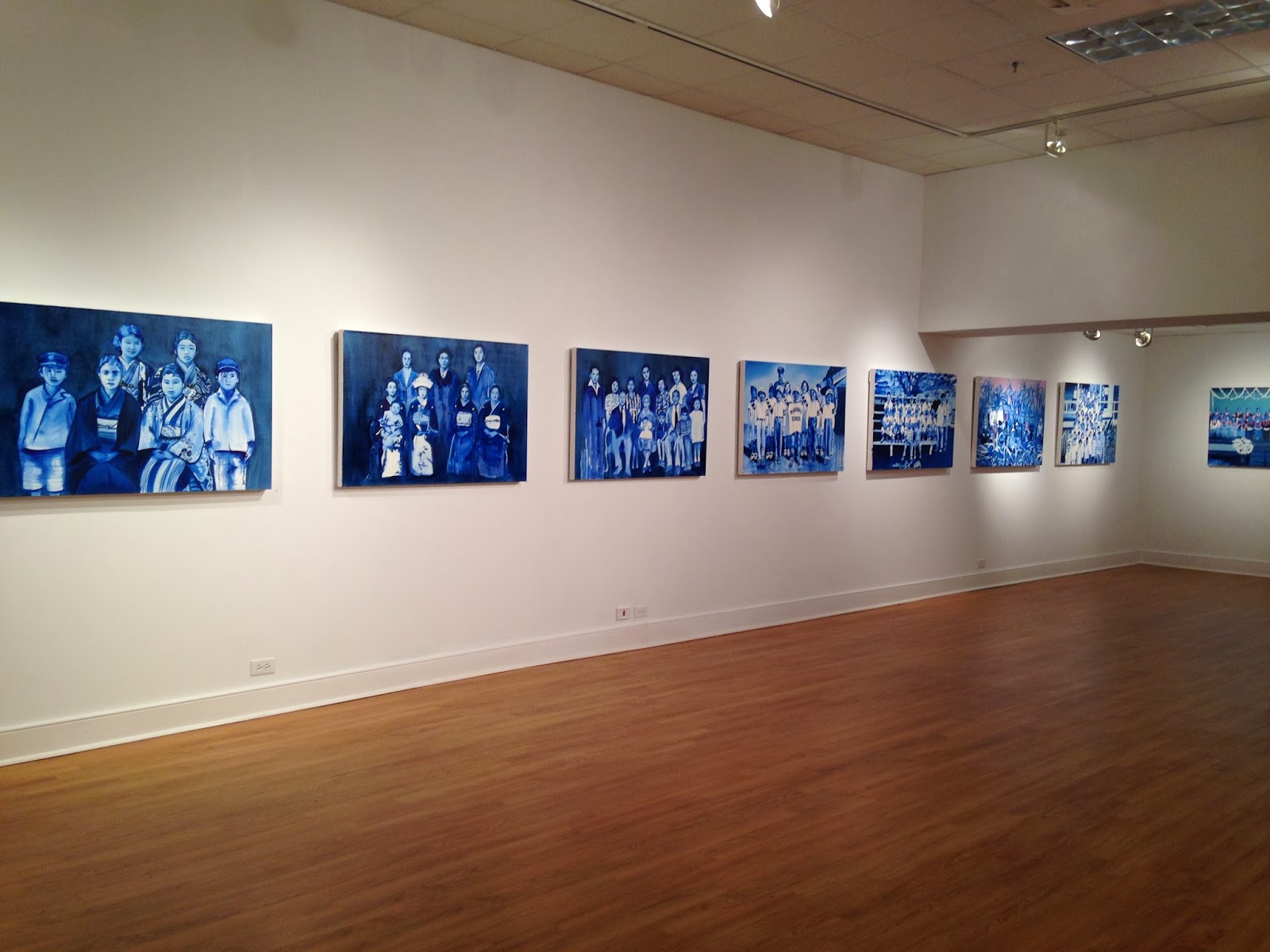
Blue Hawaii installation shots and catalog - "Okinawan Diaspora Blues"
My solo show "Blue Hawaii" opened on Feb 21st at the University of Memphis and it will be on view through March 27, 2014
Laura Kina: Blue Hawaii
The Martha and Robert Fogelman Galleries of Contemporary Art
University of Memphis
Art Department
Art and Communication Building
3715 Central Ave.
Memphis, TN 38152
Tel 901-678-2216
University of Memphis
Art Department
Art and Communication Building
3715 Central Ave.
Memphis, TN 38152
Tel 901-678-2216
Download the exhibition catalog and read Wesley Uenetan's essay "Okinawan Diaspora Blues": http://issuu.com/laurakina/docs/blue-hawaii-catalog
https://www.facebook.com/FOGELMANCONTEMPORARY
You won’t find Elvis or surfboards or funny umbrella-topped cocktails in Laura Kina’s dystopic Blue Hawaiʻi. Drawn from family albums, oral history and community archives from Hawaii and Okinawa, these ghostly oil paintings employ distilled memories to investigate themes of distance, longing, and belonging.
 | ||
| Below are some snapshots of the installation. |



Interview with upcoming CultureFest Performer Laura Kina
Posting a March 7, 2014 interview conducted by Heather C. Lou from the Multiracial Network's blog for their upcoming March 30, 2014 Culture Fest where I'll be talking about some of my recent paintings (they have me listed as "performing"...yikes!).
Laura Kina
http://multiracialnetwork.wordpress.com/2014/03/07/interview-with-upcoming-culturefest-performer-laura-kina/
As ACPA draws closer, get excited with a weekly dose of MRN Blogs! Hope to see you in Indy soon. Whether you will make it or not, we remain united in solidarity over multiracial endeavors!
To start us off, we have an interview from our CultureFest performer Laura Kina! As can also be found on her website (http://www.laurakina.com/) Laura is an artist and scholar who focuses “on the fluidity of cultural difference and the slipperiness of identity”. With subjects ranging from Asian American history to mixed race representation, her work blends autobiography with artwork, breaking down stories and putting them back together. Come see her perform “Hapa Yonsei Uchinanchu” her “talk story” about her Okinawan family history in Hawaii and her multiracial identity while showing images of her recent oil paintings and much more! Check her out at CultureFest on Sunday March 30 from 6-9pm in the Convention Center, as part of CelebrACPA immediately after the opening ceremony.
**
1. Where and how do you get your inspiration for your art?
2. Do you have a favorite piece of art you’ve created? Why?
[I’m going to answer both questions at once below]
My artwork usually starts out with an autobiographical impulse and series of questions and then develops as I gather source materials and do field research. For example, in my current exhibition Blue Hawaiʻi, which is on view through March 27, 2014 at the University of Memphis Fogelman Galleries of Contemporary Art, I initially traveled to Hawaiʻi in 2009 to look at community and family photos and interview elders in my dad’s Pi’ihonua sugarcane plantation community on the Big Island of Hawaiʻi as well as other Nisei (2nd generation) and Sansei (3rd generation) from nearby plantations. I grew up in a small Norwegian town called Poulsbo, WA and aside from my dad and my grandma Kina, I was pretty cut off from this part of my heritage. We’d go back as tourists and grew up eating Spam Musubi but I wanted to learn about the real Hawaiʻi and what it means to be Uchinanchu (Okinawan).
I initially was going to collect “obake” ghost stories Glenn Grant style inspired by the tales I’d heard of hinotama (fireballs) shooting into the night sky from the old graveyard that surrounded their plantation. I also wanted to find out what the issei (first generation) of “picture brides” immigrants lives were like. This was my own great-grandmother’s story of having an arranged marriage and arriving in Hawaiʻi around 1919. Her life was a mystery to me. So I saw a parallel between these fireballs and wanted to learn about her – of things disappearing and leaving just a trace in the night sky. But when I got into doing the interviews I realized that the folks I talked to didn’t see these “ghost” tales as fantastical or even spooky stories but more akin to Native Hawaiian mythology and manifestations of the spirit world that should be respected or that are useful for us to understand what is kapu (forbidden or off limits). There were also humorous ghost stories, like Kimotori the liver taker, that their parents used for practical purposes to keep the kids out of danger while they were busy working in the fields. Kimotori supposedly lived under a bridge and the kids would have to race home from school over this bridge back to home. Fear of Kimotori kept them from loitering around the water, which could have been a risk for drowning. I also learned how impactful WWII, military service, access to higher education, and the collapse of the sugar industry was on their lives. My image of these kimono clad “picture brides” was quickly replaced by stories of very tough and resourceful women who ran underground awamori (Okinawan sake) mills to subsidize their meager incomes as sharecroppers. They got up early and rolled Bull Duram cigarettes and packed metal tin lunch boxes of rice, dried fish, and pickles and headed out into the fields before the sun rose each day.
After completing the first round of works based on this research for a solo show called Sugar in 2010, this eventually led to my father and I traveling together again to Okinawa in 2012 to collect additional stories of heritage and history. The finished series of 23 oil paintings compress time and space between Okinawa and Hawaiʻi and capture the remnants of WWII and a continued American military presence in contemporary Okinawa and trace my family’s immigration from Okinawa to Hawaiʻi and the process of assimilation and citizenship against the backdrop of larger issues of settler-colonialism. The works are also a way to actively remember the four family members who were killed during the 1945 Battle of Okinawa. Although it was impossible to know that I was going to cover all of this while I was making the work, this is where the research led me – from a fantasy of ghosts and picture brides to learning about the very real hauntings of history and connecting to the community in Hawaiʻi and to my extended family in Okinawa. Remembering ended up being a radical act.
My favorite painting from this series is called “Issei” and it is a double portrait of my great-grandma Makato Gibu Hiyane and her mother Makato Maehira. I found the source image for this when my own Grandma Kina died and we were working on a memorial video. I thought the photo was of my great-grandma and I painted her here with a row of plantation workers in the background. When I took the image back to Hawaiʻi, aunties pointed out that I had painted a twist on the Native Hawaiian myth of the night marchers. When I took the image back to Okinawa, my relatives noted that this image was of my great-great-grandma who had died during the Battle of Okinawa. It was through this image that I began to learn the truth about what happened to our family during the WWII. Up until this point it wasn’t something anyone talked about. The image has gone one to be used by the Smithsonian in their traveling banner exhibition “I Want the Wide American Earth: An Asian Pacific American Story” to talk about plantation history in Hawaiʻi.
View the complete series and download the exhibition catalog and read the essay “Okinawan Diaspora Blues” by Wesley Ueneten, Associate Professor of Asian American Studies San Francisco State University: http://www.laurakina.com/newwork2013.html
3. How did you begin your academic career in Mixed Race Studies?
This was a somewhat organic process too. I was working on a series of painting in 2002-2005 called “Hapa Soap Opera” and I was initially just painting friends and family of mine who were mixed Asian and another race. Along this process I learned about Hapa Issues Forum in California and the MAVIN Foundation in Seattle and I started to get connected with the multiracial movement on a national level. Before that time, mixed identity was a thing we just talked about in our own family and we used the Hawaiian word “hapa” to name what we were. I’d already been very grounded in Asian American arts and a collectivized and activist identity but over the course of time I had noticed that more and more of us in Asian American arts were in fact “mixed” and this was something I wanted to explore in my artwork. Eventually, of course, I had to think about mixedness beyond just “hapa” identity and this led me to make my 2006 Loving series, which featured 10 charcoal portraits of mixed race individuals. They were all born in the years after the 1967 Loving vs. Virginia Supreme Court Case, which overturned our nation’s last anti-miscegenation laws. I wanted to capture who we (mixed folks) are a virtual community in one sense but also quite disconnected. Since I had converted to Judaism back in 1997 I was also thinking about the idea of a minyan– with 10 being the minimum number of people you need to pray. Of course in the Jewish context this needs to be 10 Jewish adults but I was thinking about this in relation to what makes community. Over the course of 2002-2006 from the Hapa Soap Opera and Loving series, my virtual community of subjects started to be a real community.
By winter of 2008 I found myself at a Multiracial Leadership retreat outside of San Francisco organized and attended by Hapa Issues Forum, iPride, MASC, and MAVIN asking what the next steps were for “our” community. After the push for the one or more option on the 2000 U.S. and then the nomination of President Barack Obama, there was a collective question of what the next national project should be. There also seemed to be a waning interest in the social support groups and networks that were established in the 1980s and 1990s. With the growing social acceptance of mixed race people and families, there just didn’t seem to be as much demand to meet in groups. This experience raised a whole new set of questions. On one hand I felt a certain homecoming to finally find a whole community of other “mixed” people out there. I wasn’t certain what this meant yet for Asian America and I couldn’t see how, other than a common experience of racism, we were historically connected. I just had a lot of questions that I couldn’t articulate at the time but I was happy to make so many new friends but a little skeptical about all this claim to “newness” and the “multiracial millennium” and what the New York Time’s was calling “Generation E” (Ethnically Ambiguous). In the art world there had already been 7+ years of rhetoric around entering a so-called post-racial era and President Barack Obama’s election seemed like the proof. In retrospect this was really problematic and was happening at the same time that we saw and continue to see Islamaphobia on the rise post-9/11.
4. What was the process of creating, organizing, and implementing the Critical Mixed Race Studies Conference?
I went to this 2008 leadership retreat with my DePaul colleague Camilla Fojas. She had just published her co-edited book Mixed Race Hollywood (NYU Press, 2008) with Mary Beltran and I was beginning to teach a class called “Mixed Race Art and Identity.” We were doing a workshop activity where you put post-it notes up on a wall with where you see yourself in five years in the multiracial movement and what you want to work on. After everyone had their dreams on the wall, we moved out post-it notes around to align with each other. It was out of this activity and other theater and drawing activities that Camilla Fojas, and Wei Ming Dariotis from San Francisco State University, and I had the very practical idea to work towards legitimizing multiracial studies in an academic context. Our hope was to found an association for critical mixed race studies. We used the word “critical” from “critical race” theory to point towards systems of racialization and used the “mixed race” (with no hyphen) from what was being used at the time (as opposed to “multiracial”) to define the movement. The no hyphen comes from us ditching hyphenated identities in Asian America. I know this is confusing when “mixed-race” is used as a compound modifier! We sat down and hammered out a definition, which we are still using today for Critical Mixed Race Studies:
Critical Mixed Race Studies is the transracial, transdisciplinary, and transnational critical analysis of the institutionalization of social, cultural, and political orders based on dominant conceptions of race. CMRS emphasizes the mutability of race and the porosity of racial boundaries in order to critique processes of racialization and social stratification based on race. CMRS addresses local and global systemic injustices rooted in systems of racialization.
But before we could found an association we figured we should start small by organizing a conference. We sent out a call for papers in 2009 and by the time the inaugural conference “Emerging Paradigms in Critical Mixed Race Studies” took shape in November 2010 we had over 200 paper submissions and 430 people attended. What was unique about this first conference is that it wasn’t a student conference, as most large-scale meetings on multiraciality had been up to this point. It was an academic conference but it also recognized the movements community roots and included arts and community programming and it drew national and international participation. For our subsequent 2012 conference “What is Critical Mixed Race Studies?”, which over 450 people attended, we sought to keep this core spirit but wished to professionalize the process to ensure peer review but to also create a sustainable process for the conference can keep going. Camilla Fojas worked with an external panel of reviewers to select the papers and I partnered with Mixed Roots Stories to organize arts programming. We are doing this again for the Nov 13-15, 2014 conference “Global Mixed Race.”
To read in detail about the history of multiracial studies in the U.S. and the founding of Critical Mixed Race Studies, please read the inaugural issue of the Journal of Critical Mixed Race Studies article “Emerging Paradigms in Critical Mixed Race Studies” by G. Reginald Daniel, Laura Kina, Wei Ming Dariotis, and Camilla Fojas.
http://escholarship.org/uc/ucsb_soc_jcmrs
5. If you had one word to use to describe your creative/artistic style, what would it be?
Archive
6. Lastly, do you have any advice to our budding artists?
Knowing your craft – not only the technical aspects but the history too. As a painter I need to know how to paint and hopefully be damn good at it but also really engage with the entire history of painting and all of it’s possibilities. Work with deadlines and parameters and clear goals but also sink yourself into research and get lost and take risks. I also have really personally benefited from a practice where I incorporate collaboration and accountability to specific communities. This means my artwork is drawn from and gives back to these communities but it also means that these groups sustain me and keep me on point.
**
Thanks to MRN Co-Chair Heather Lou for coordinating this blog post and of course to Laura Kina for sharing her time with us!
Laura Kina
 |
| Laura Kina, Issei, oil on canvas, 2011 |
http://multiracialnetwork.wordpress.com/2014/03/07/interview-with-upcoming-culturefest-performer-laura-kina/
As ACPA draws closer, get excited with a weekly dose of MRN Blogs! Hope to see you in Indy soon. Whether you will make it or not, we remain united in solidarity over multiracial endeavors!
To start us off, we have an interview from our CultureFest performer Laura Kina! As can also be found on her website (http://www.laurakina.com/) Laura is an artist and scholar who focuses “on the fluidity of cultural difference and the slipperiness of identity”. With subjects ranging from Asian American history to mixed race representation, her work blends autobiography with artwork, breaking down stories and putting them back together. Come see her perform “Hapa Yonsei Uchinanchu” her “talk story” about her Okinawan family history in Hawaii and her multiracial identity while showing images of her recent oil paintings and much more! Check her out at CultureFest on Sunday March 30 from 6-9pm in the Convention Center, as part of CelebrACPA immediately after the opening ceremony.
**
1. Where and how do you get your inspiration for your art?
2. Do you have a favorite piece of art you’ve created? Why?
[I’m going to answer both questions at once below]
My artwork usually starts out with an autobiographical impulse and series of questions and then develops as I gather source materials and do field research. For example, in my current exhibition Blue Hawaiʻi, which is on view through March 27, 2014 at the University of Memphis Fogelman Galleries of Contemporary Art, I initially traveled to Hawaiʻi in 2009 to look at community and family photos and interview elders in my dad’s Pi’ihonua sugarcane plantation community on the Big Island of Hawaiʻi as well as other Nisei (2nd generation) and Sansei (3rd generation) from nearby plantations. I grew up in a small Norwegian town called Poulsbo, WA and aside from my dad and my grandma Kina, I was pretty cut off from this part of my heritage. We’d go back as tourists and grew up eating Spam Musubi but I wanted to learn about the real Hawaiʻi and what it means to be Uchinanchu (Okinawan).
I initially was going to collect “obake” ghost stories Glenn Grant style inspired by the tales I’d heard of hinotama (fireballs) shooting into the night sky from the old graveyard that surrounded their plantation. I also wanted to find out what the issei (first generation) of “picture brides” immigrants lives were like. This was my own great-grandmother’s story of having an arranged marriage and arriving in Hawaiʻi around 1919. Her life was a mystery to me. So I saw a parallel between these fireballs and wanted to learn about her – of things disappearing and leaving just a trace in the night sky. But when I got into doing the interviews I realized that the folks I talked to didn’t see these “ghost” tales as fantastical or even spooky stories but more akin to Native Hawaiian mythology and manifestations of the spirit world that should be respected or that are useful for us to understand what is kapu (forbidden or off limits). There were also humorous ghost stories, like Kimotori the liver taker, that their parents used for practical purposes to keep the kids out of danger while they were busy working in the fields. Kimotori supposedly lived under a bridge and the kids would have to race home from school over this bridge back to home. Fear of Kimotori kept them from loitering around the water, which could have been a risk for drowning. I also learned how impactful WWII, military service, access to higher education, and the collapse of the sugar industry was on their lives. My image of these kimono clad “picture brides” was quickly replaced by stories of very tough and resourceful women who ran underground awamori (Okinawan sake) mills to subsidize their meager incomes as sharecroppers. They got up early and rolled Bull Duram cigarettes and packed metal tin lunch boxes of rice, dried fish, and pickles and headed out into the fields before the sun rose each day.
After completing the first round of works based on this research for a solo show called Sugar in 2010, this eventually led to my father and I traveling together again to Okinawa in 2012 to collect additional stories of heritage and history. The finished series of 23 oil paintings compress time and space between Okinawa and Hawaiʻi and capture the remnants of WWII and a continued American military presence in contemporary Okinawa and trace my family’s immigration from Okinawa to Hawaiʻi and the process of assimilation and citizenship against the backdrop of larger issues of settler-colonialism. The works are also a way to actively remember the four family members who were killed during the 1945 Battle of Okinawa. Although it was impossible to know that I was going to cover all of this while I was making the work, this is where the research led me – from a fantasy of ghosts and picture brides to learning about the very real hauntings of history and connecting to the community in Hawaiʻi and to my extended family in Okinawa. Remembering ended up being a radical act.
My favorite painting from this series is called “Issei” and it is a double portrait of my great-grandma Makato Gibu Hiyane and her mother Makato Maehira. I found the source image for this when my own Grandma Kina died and we were working on a memorial video. I thought the photo was of my great-grandma and I painted her here with a row of plantation workers in the background. When I took the image back to Hawaiʻi, aunties pointed out that I had painted a twist on the Native Hawaiian myth of the night marchers. When I took the image back to Okinawa, my relatives noted that this image was of my great-great-grandma who had died during the Battle of Okinawa. It was through this image that I began to learn the truth about what happened to our family during the WWII. Up until this point it wasn’t something anyone talked about. The image has gone one to be used by the Smithsonian in their traveling banner exhibition “I Want the Wide American Earth: An Asian Pacific American Story” to talk about plantation history in Hawaiʻi.
View the complete series and download the exhibition catalog and read the essay “Okinawan Diaspora Blues” by Wesley Ueneten, Associate Professor of Asian American Studies San Francisco State University: http://www.laurakina.com/newwork2013.html
3. How did you begin your academic career in Mixed Race Studies?
This was a somewhat organic process too. I was working on a series of painting in 2002-2005 called “Hapa Soap Opera” and I was initially just painting friends and family of mine who were mixed Asian and another race. Along this process I learned about Hapa Issues Forum in California and the MAVIN Foundation in Seattle and I started to get connected with the multiracial movement on a national level. Before that time, mixed identity was a thing we just talked about in our own family and we used the Hawaiian word “hapa” to name what we were. I’d already been very grounded in Asian American arts and a collectivized and activist identity but over the course of time I had noticed that more and more of us in Asian American arts were in fact “mixed” and this was something I wanted to explore in my artwork. Eventually, of course, I had to think about mixedness beyond just “hapa” identity and this led me to make my 2006 Loving series, which featured 10 charcoal portraits of mixed race individuals. They were all born in the years after the 1967 Loving vs. Virginia Supreme Court Case, which overturned our nation’s last anti-miscegenation laws. I wanted to capture who we (mixed folks) are a virtual community in one sense but also quite disconnected. Since I had converted to Judaism back in 1997 I was also thinking about the idea of a minyan– with 10 being the minimum number of people you need to pray. Of course in the Jewish context this needs to be 10 Jewish adults but I was thinking about this in relation to what makes community. Over the course of 2002-2006 from the Hapa Soap Opera and Loving series, my virtual community of subjects started to be a real community.
By winter of 2008 I found myself at a Multiracial Leadership retreat outside of San Francisco organized and attended by Hapa Issues Forum, iPride, MASC, and MAVIN asking what the next steps were for “our” community. After the push for the one or more option on the 2000 U.S. and then the nomination of President Barack Obama, there was a collective question of what the next national project should be. There also seemed to be a waning interest in the social support groups and networks that were established in the 1980s and 1990s. With the growing social acceptance of mixed race people and families, there just didn’t seem to be as much demand to meet in groups. This experience raised a whole new set of questions. On one hand I felt a certain homecoming to finally find a whole community of other “mixed” people out there. I wasn’t certain what this meant yet for Asian America and I couldn’t see how, other than a common experience of racism, we were historically connected. I just had a lot of questions that I couldn’t articulate at the time but I was happy to make so many new friends but a little skeptical about all this claim to “newness” and the “multiracial millennium” and what the New York Time’s was calling “Generation E” (Ethnically Ambiguous). In the art world there had already been 7+ years of rhetoric around entering a so-called post-racial era and President Barack Obama’s election seemed like the proof. In retrospect this was really problematic and was happening at the same time that we saw and continue to see Islamaphobia on the rise post-9/11.
4. What was the process of creating, organizing, and implementing the Critical Mixed Race Studies Conference?
I went to this 2008 leadership retreat with my DePaul colleague Camilla Fojas. She had just published her co-edited book Mixed Race Hollywood (NYU Press, 2008) with Mary Beltran and I was beginning to teach a class called “Mixed Race Art and Identity.” We were doing a workshop activity where you put post-it notes up on a wall with where you see yourself in five years in the multiracial movement and what you want to work on. After everyone had their dreams on the wall, we moved out post-it notes around to align with each other. It was out of this activity and other theater and drawing activities that Camilla Fojas, and Wei Ming Dariotis from San Francisco State University, and I had the very practical idea to work towards legitimizing multiracial studies in an academic context. Our hope was to found an association for critical mixed race studies. We used the word “critical” from “critical race” theory to point towards systems of racialization and used the “mixed race” (with no hyphen) from what was being used at the time (as opposed to “multiracial”) to define the movement. The no hyphen comes from us ditching hyphenated identities in Asian America. I know this is confusing when “mixed-race” is used as a compound modifier! We sat down and hammered out a definition, which we are still using today for Critical Mixed Race Studies:
Critical Mixed Race Studies is the transracial, transdisciplinary, and transnational critical analysis of the institutionalization of social, cultural, and political orders based on dominant conceptions of race. CMRS emphasizes the mutability of race and the porosity of racial boundaries in order to critique processes of racialization and social stratification based on race. CMRS addresses local and global systemic injustices rooted in systems of racialization.
But before we could found an association we figured we should start small by organizing a conference. We sent out a call for papers in 2009 and by the time the inaugural conference “Emerging Paradigms in Critical Mixed Race Studies” took shape in November 2010 we had over 200 paper submissions and 430 people attended. What was unique about this first conference is that it wasn’t a student conference, as most large-scale meetings on multiraciality had been up to this point. It was an academic conference but it also recognized the movements community roots and included arts and community programming and it drew national and international participation. For our subsequent 2012 conference “What is Critical Mixed Race Studies?”, which over 450 people attended, we sought to keep this core spirit but wished to professionalize the process to ensure peer review but to also create a sustainable process for the conference can keep going. Camilla Fojas worked with an external panel of reviewers to select the papers and I partnered with Mixed Roots Stories to organize arts programming. We are doing this again for the Nov 13-15, 2014 conference “Global Mixed Race.”
To read in detail about the history of multiracial studies in the U.S. and the founding of Critical Mixed Race Studies, please read the inaugural issue of the Journal of Critical Mixed Race Studies article “Emerging Paradigms in Critical Mixed Race Studies” by G. Reginald Daniel, Laura Kina, Wei Ming Dariotis, and Camilla Fojas.
http://escholarship.org/uc/ucsb_soc_jcmrs
5. If you had one word to use to describe your creative/artistic style, what would it be?
Archive
6. Lastly, do you have any advice to our budding artists?
Knowing your craft – not only the technical aspects but the history too. As a painter I need to know how to paint and hopefully be damn good at it but also really engage with the entire history of painting and all of it’s possibilities. Work with deadlines and parameters and clear goals but also sink yourself into research and get lost and take risks. I also have really personally benefited from a practice where I incorporate collaboration and accountability to specific communities. This means my artwork is drawn from and gives back to these communities but it also means that these groups sustain me and keep me on point.
**
Thanks to MRN Co-Chair Heather Lou for coordinating this blog post and of course to Laura Kina for sharing her time with us!
Journal of Critical Mixed Race Studies - inaugural issue "Emerging Paradigms in Critical Mixed Race Studies"

In case you missed this announcement back in January, you can now download (FOR FREE!!!) the inaugural issue of the Journal of Critical Mixed Race Studies (JCMRS) "Emerging Paradigms in Critical Mixed Race Studies" Volume 1, No. 1, 2014.
http://escholarship.org/uc/ucsb_soc_jcmrs
The Journal of Critical Mixed Race Studies (JCMRS) is a peer-reviewed online journal dedicated to Critical Mixed Race Studies (CMRS). Launched in 2011, it is the first academic journal explicitly focused on Critical Mixed Race Studies. Sponsored by UC Santa Barbara’s Sociology Department, JCMRS is hosted on the eScholarship Repository, which is part of the eScholarship initiative of the California Digital Library. The inaugural issue “Emerging Paradigms in Critical Mixed Race Studies” was published in January 2014.
Front Matter
Cover ArtTable of Contents
Editor's Note
Daniel, G. Reginald
Emerging Paradigms in Critical Mixed Race Studies
Daniel, G. Reginald; Kina, Laura; Dariotis, Wei Ming; Fojas, Camilla
Appendix A: Publications from 1989 to 2004
Riley, Steven F.
Appendix B: Publications from 2005 to 2013
Riley, Steven F.
Articles
Historical Origins of the One-Drop Racial Rule in the United StatesJordan, Winthrop D.
Reconsidering the Relationship Between New Mestizaje and New Multiraciality as Mixed-Race Identity Models
Turner, Jessie D.
Critical Mixed Race Studies: New Directions in the Politics of Race and Representation
Jolivétte, Andrew J.
"Only the News They Want to Print": Mainstream Media and Critical Mixed-Race Studies
Spencer, Rainier
The Current State of Multiracial Discourse
McKibbin, Molly Littlewood
Slimy Subjects and Neoliberal Goods: Obama and the Children of Fanon
McNeil, Daniel
Book Reviews
Stephen Murphy-Shigematsu, When Half Is Whole: Multiethnic Asian Americans IdentitiesCrawford, Miki Ward
Ralina Joseph, Transcending Blackness: From the New Millennium Mulatta to the Exceptional Multiracial
Elam, Michele
Greg Carter, The United States of the United Races: A Utopian History of Racial Mixing
Mount, Guy Emerson
Rudy P. Guevarra, Jr., Becoming Mexipino: Multiethnic Identities and Communities in San Diego
Schlund-Vials, Cathy J.
About the Contributors
About the ContributorsMonday, February 17, 2014
"Blue Hawai'i" solo show opening at the University of Memphis
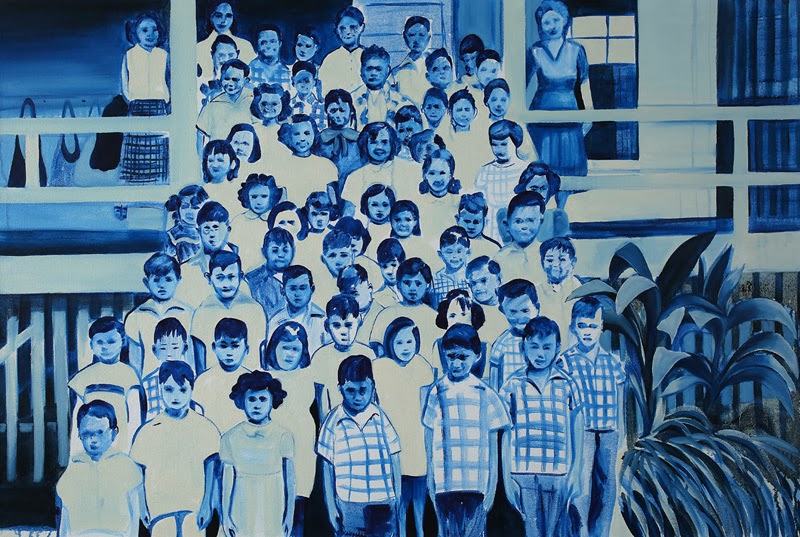 |
Laura Kina, Elementary School, 30x45 in, oil on canvas, 2013 |
University of Memphis
The Martha and Robert Fogelman Galleries of Contemporary Art
Laura Kina: Blue Hawai'i
February 21 - March 27, 2014
Opening reception: Friday, Feb 21 5:30-8:00pm
Artist talk: Thursday, Feb 20 7:00pm 3715 Central Ave. #310
"Remembering Painting, Forgetting Photographs"
University of Memphis
The Martha and Robert Fogelman Galleries of Contemporary Art
Art Department
Art and Communication Building
3715 Central Ave.
Memphis, TN 38152
Tel 901-678-2216
http://memphis.edu/art/fogelmangalleries.php
https://www.facebook.com/FOGELMANCONTEMPORARY
Join the event on Facebook
All events are free and open to the public.
View the digital exhibition catalog featuring an essay "Okinawan Diaspora Blues" by Wesley Uenten, Associate Professor of Asian American Studies San Francisco State University
See the works online
You won’t find Elvis or surfboards or funny umbrella-topped cocktails in Laura Kina’s dystopic Blue Hawaiʻi. Drawn from family albums, oral history and community archives from Hawaii and Okinawa, these ghostly oil paintings employ distilled memories to investigate themes of distance, longing, and belonging.
Featuring new works and a selection from her ongoing Sugar series (2009-present), the setting is Kina’s father’s Okinawan sugarcane field plantation community, Piʻihonua, on the Big Island of Hawaiʻi near Hilo. Her obsession with blue was inspired by the indigo-dyed kasuri kimonos repurposed by the Issei (first generation) “picture bride” immigrants for canefield work clothes, and colored by stories of hinotama (fireballs) shooting from the canefield cemetery into the night sky. Blue Hawaiʻi echoes the spirits of Kina’s ancestors and shared histories of labor migration.
Wednesday, January 22, 2014
Okinawa Study Abroad Reflections and Creative Projects
Tonight was the last class for our DePaul University Okinawa Study abroad trip. My colleague Kathryn Ibata-Arens and I combined a 300-level political science and a 300-level studio art course together to create our trip - "Okinawa, Art, Politics, and Economy." I was skeptical that this mix would work when it came to creating final art projects with open ended instructions but our interdisciplinary mix of students took us by surprise.
Here is one stunning example from an Animation/Anthropology student, Letitia Longbons, for the final trip creative project. Her stop frame animation has over 200+ drawings done by hand!!!
https://vimeo.com/84831472
Jordan Johnson, an Information Technology major and Global Asian Studies minor student, created a dedicated website for his trip journal (I'll post an interactive map shortly that he just created):
http://www.josamjohn.com/
Sylwia Kusiak, an Intercultural Communications and Art, Media, & Design student, created a Tumblr to reflect on our trip to Okinawa:
http://www.okinawask.tumblr.com/
Even my colleague Kathryn Ibata-Arens got into the creative zone and enlisted the help of her teenage daughter to make a YouTube video about our trip:
I documented the students and our visiting speakers and field trips: http://www.flickr.com/photos/63834915@N03/sets/72157638534311554/
We are looking forward to running this program again in December 2015!
Here is one stunning example from an Animation/Anthropology student, Letitia Longbons, for the final trip creative project. Her stop frame animation has over 200+ drawings done by hand!!!
https://vimeo.com/84831472
Jordan Johnson, an Information Technology major and Global Asian Studies minor student, created a dedicated website for his trip journal (I'll post an interactive map shortly that he just created):
http://www.josamjohn.com/
Sylwia Kusiak, an Intercultural Communications and Art, Media, & Design student, created a Tumblr to reflect on our trip to Okinawa:
http://www.okinawask.tumblr.com/
Even my colleague Kathryn Ibata-Arens got into the creative zone and enlisted the help of her teenage daughter to make a YouTube video about our trip:
I documented the students and our visiting speakers and field trips: http://www.flickr.com/photos/63834915@N03/sets/72157638534311554/
We are looking forward to running this program again in December 2015!
Tuesday, January 7, 2014
Save the date - February 2014 lectures and panels
Upcoming Lectures and Panels
Threewalls Gallery
Friday, February 14, 2014
119 N. Peoria #2C
Chicago, IL 60607
tracersbookclub@gmail.com
www.tracersbookclub.com
In conjunction with Faith Wilding's Fearful Symmetries Retrospective.
TRACERS TAKES ON FEMINISM: CONVERSATIONS ABOUT MOTHERHOOD, LGBTQ AND RACE.
Panel presentations, 10AM- 5PM
Organized by Jennifer Reeder and Carrie Ruckel, Tracers
Schedule:
10am-12pm - LGBTQ
(12-1pm - lunch)
1-3pm - Motherhood 3-5pm - Race
Panelists:
LGBTQ (10am - 12pm): Latham Zearfoss (moderator), Jillian Soto , Daviel Shy , Frederick Moffet , Malic Amalya , Silvia Malagrino , Amina Ross , NIC Kay
Motherhood (1 – 3pm): Lorelei Stewart (moderator), Christa Donner , Brittany Southworth Laflamme , Judy Ledgerwood , Laura Letinsky , Romi Crawford , Julie Rodrigues Widholm , Christine Tarkowski
Race (3 – 5pm): Isis Ferguson (moderator), Laura Kina , Maria Gaspar , Indira Johnson , Laila Farah , Alberto Aguilar , Alexandria Eregbu , Sima Azadi
119 N. Peoria #2C
Chicago, IL 60607
tracersbookclub@gmail.com
www.tracersbookclub.com
In conjunction with Faith Wilding's Fearful Symmetries Retrospective.
TRACERS TAKES ON FEMINISM: CONVERSATIONS ABOUT MOTHERHOOD, LGBTQ AND RACE.
Panel presentations, 10AM- 5PM
Organized by Jennifer Reeder and Carrie Ruckel, Tracers
Schedule:
10am-12pm - LGBTQ
(12-1pm - lunch)
1-3pm - Motherhood 3-5pm - Race
Panelists:
LGBTQ (10am - 12pm): Latham Zearfoss (moderator), Jillian Soto , Daviel Shy , Frederick Moffet , Malic Amalya , Silvia Malagrino , Amina Ross , NIC Kay
Motherhood (1 – 3pm): Lorelei Stewart (moderator), Christa Donner , Brittany Southworth Laflamme , Judy Ledgerwood , Laura Letinsky , Romi Crawford , Julie Rodrigues Widholm , Christine Tarkowski
Race (3 – 5pm): Isis Ferguson (moderator), Laura Kina , Maria Gaspar , Indira Johnson , Laila Farah , Alberto Aguilar , Alexandria Eregbu , Sima Azadi
College Art Association 102nd Annual Conference
"Miscegenating Racial Representations: Critical Mixed Race Strategies and the Visual Arts"
Saturday, February 15, 2:30-5:00 PM
Hilton Chicago
720 South Michigan Avenue
Chicago, IL 60605
International South, 2nd Floor
Saturday, February 15, 2:30-5:00 PM
Hilton Chicago
720 South Michigan Avenue
Chicago, IL 60605
International South, 2nd Floor
Laura Kina, DePaul University
Margo Machida, University of Connecticut
This session will examine critical mixed race strategies for the miscegenation of racial representation in the visual arts. The 2000 U.S. Census was first to allow individuals to self enumerate as more than one race. Making multiracial populations visible both expanded the borders, blurred and posed a potential threat to existing monoracial categories. Beginning in the early 2000s there was a simultaneous neoliberal and conservative push for a postidentitarian/ postracial moment posed against the putative ossification of multicultural racial identity constructs. Curatorial frameworks and studio practices centered on race as a locus of investigation were challenged if not rendered invisible and seemingly obsolete. And yet race and attendant cultural issues have demonstrably remained pertinent for artistic production and analysis. A double tension has resulted in moves to both recognize the continuing importance of race and the critical push to reframe and disarticulate categories that cannot contain the complexity of increasingly miscegenated peoples, histories, and subjectivities. We will consider how dominant conceptions of race have changed (or not) in the visual arts as a result of the mounting discourses and bodies of artistic production that bring forward mixed race identity in various domestic, transnational and international contexts.
"Beyond the Bronze Venus"
Alison Fraunhar, Saint Xavier University
"Sensory Miscegenations: Representing Multiracial Bodies"
Sita Kuratomi Bhaumik, University of California Merced
"Lacuna"
Maya Isabella Mackrandilal, artist
"Liminal Embodiments"
Zavé Martohardjono, artist
"Risky Subjectivity: Select Works by Korean Adoptee Artists"
Eun Jung Park, independent scholar
Macalester College 15th Annual American Studies Conference
February 27-28, 2014
Thursday, Feb. 27th Keynote Speakers - Laura Kina and Ralina Joseph
Laura Kina "Mixed Race Asian American Art: On Becoming and Unbecoming a 'Happy Hapa'"
Friday, Feb 28th panel "Being Mixed Race" - Shannon Gibney, Marcus Gardley, Ralina Joseph, Laura Kina
Saturday, January 4, 2014
Critical Mixed Race Studies and Mixed Roots Stories Call for Papers

My DePaul colleague Camilla Fojas and our team of volunteers are gearing up for "Global Mixed Race," the 3rd biennial Critical Mixed Race Studies (CMRS) conference, at DePaul Nov 13-15, 2014. The call for panels, papers, and round table submissions for the conference is due January 15, 2014. Also due on January 15th, the CMRS Mixed Roots Stories cultural programming is looking for short films and and stand-up comedy, spoken word, dance, short scenes, monologues, vocalists, musicians – or other forms of live performance.
Read more about the conference: http://criticalmixedracestudies.org/wordpress/cmrs-2014/
Study Abroad trip Okinawa, Japan Dec 3-15, 2013

December 3-15, 2013 my colleague Kathryn Ibata-Arens and I led 16 students on a DePaul University College of Liberal Arts and Social Sciences Short-Term Study Abroad trip to Okinawa, Japan "Okinawa: Art, Politics and Economy." This trip was sponsored in part by the Japan Foundation. Many thanks to all the friends, family, and the international network of scholars, artists, and activist who helped make this dream trip a reality! We plan to run this trip again in Dec 2015 and 2017 so DePaul students stay tuned.
We are pictured here at the dojo of Grand Master Shinzato Katsuhiko sensei after a Shorin-ryu Kishaba Juko karate demonstration and workshop.
View our trip photos: http://www.flickr.com/photos/63834915@N03/sets/72157638534311554/
War Baby / Love Child: Only two more weeks left!
Hope you can stop by The Wing to see War Baby / Love Child: Mixed Race Asian American Art, before it closes on Jan. 19. See the website for more information on the exhibit and book curated by Laura Kina and Wei Ming Dariotis: http://www.warbabylovechild.com/exhibition/
Recently added are seven artist interviews, conducted by LeiLani Nishime’s Race and Public Scholarship class. The students created QR codes that link to the audio interviews which are posted in the exhibit near the entry and include Albert Chong, Kip Fulbeck, Jane Jin Kaisen, Lori Kay, Richard Lou, Gina Osterloh and Jennifer Wofford.
Also, on Saturday, Jan. 11 at 2pm there will be a screening of A Lot Like You, Eliaichi Kimaro’s powerful award-winning documentary. Read more about the film: http://alotlikeyoumovie.com/
A discussion with Kimaro will follow the screening. Tickets include general gallery access: $10 general, $8 Museum members. Reserve your tickets by calling 206-623-5124.
Michelle Kumata
Exhibit Director
Wing Luke Museum of the Asian Pacific American Experience
719 South King St.
Seattle, WA 98104
206.623.5124 Ext. 124
mkumata@wingluke.org
www.wingluke.org
Recently added are seven artist interviews, conducted by LeiLani Nishime’s Race and Public Scholarship class. The students created QR codes that link to the audio interviews which are posted in the exhibit near the entry and include Albert Chong, Kip Fulbeck, Jane Jin Kaisen, Lori Kay, Richard Lou, Gina Osterloh and Jennifer Wofford.
Also, on Saturday, Jan. 11 at 2pm there will be a screening of A Lot Like You, Eliaichi Kimaro’s powerful award-winning documentary. Read more about the film: http://alotlikeyoumovie.com/
A discussion with Kimaro will follow the screening. Tickets include general gallery access: $10 general, $8 Museum members. Reserve your tickets by calling 206-623-5124.
Michelle Kumata
Exhibit Director
Wing Luke Museum of the Asian Pacific American Experience
719 South King St.
Seattle, WA 98104
206.623.5124 Ext. 124
mkumata@wingluke.org
www.wingluke.org
Subscribe to:
Posts (Atom)