
Saturday, September 3, 2011


Sunday, August 21, 2011
Art in a small town: on juried shows – Real People 2011
I grew up in a small town but I couldn’t breath in a small town. For the past 8 years I’ve lived in a South Asian neighborhood in Chicago, where the savory curry air and minor key of the call to prayer is occasionally punctuated by mariachi music and the pounding base of a sub woofer.
It’s anything but country but I do remember that it was in the country, in Sunshine Studios under the tutelage of portrait and landscape plein air artist and retired U.S. Air Force wife Phyllis Oliver and afterschool popcorn sprinkled with lemon pepper, classical music and a good dose of Right vs. Left political debates, that I learned the fundamentals of painting and drawing. And it was in the North Kitsap Junior High School gym, on portable gray folding walls during my hometown of Poulsbo’s annual Viking Fest, that I learned that the art that gets the most reaction from the crowd probably won’t win first prize - in 1989, I made a disturbing assemblage painting, inspired by the Dec. 1988 Lockerbie Bombing, which featured Barbie doll legs blasting out of the side of the Pan Am Flight 103. Many a mother’s tongue clucked, “What has the world come to that our youth are focusing on so much violence?!” I think the painting is still somewhere in my parent’s basement and the bomber, Abdelbasset al Megrahi, was released in 2009 after being diagnosed with terminal prostate cancer.
Earlier this summer I got an invitation to jury a national figurative art show for The Northwest Area Arts Council (NAAC) called “Real People 2011” (most likely as a result of my realistic 2006 charcoal Loving series). Despite NY gallerist and art world mavin Edward Winkleman’s advice on juried exhibitions and my general principle never to participate in shows where there is an entry fee involved, I said yes and was promptly sent a link to review over four hundred art works. I had no idea who the artists were or where they were coming from. All I had were the visuals and a brief description of the work. I ranked them on a scale of 1-20 and my results were compiled with two other jurors (Chicago gallerist Dan Addington of Addington Gallery and a McHenry county artist Rodger Bechtold) and then 80 works, that received the highest average ranking, were selected.
The NAAC organizers graciously invited me to meet them to review the show early and eat lunch with them at LaPetite Creperie. Sure, no problem. The day I went to meet them, I realized that I thought I was jurying an art show in Chicago at the “Near Northwest Arts Council" (Wicker Park Center). I believe in giving back to the community and I remembered that when I was very young, I had been selected for a juried show at that venue. But this show was for the “Norwest Area Arts Council” in McHenry County in Woodstock, IL! An hour and a half northwest of Chicago through cornfields and too many toll ways, Woodstock was put on the Hollywood map by Bill Murry in the 1993 Groundhog Day movie.
 |
| Old Court House Art Center in Woodstock, IL |
Upon walking into the old courthouse/jail where the exhibition is held, my first impression was surprise that I really had no idea about the sense of scale from seeing works online. Almost without fail, every work was a different size than what I had imagined. You also have no sense of resolution in photographs online or the surface and texture of a work. Subtlety and nuance just can’t compete online. So what stands out instead are bold blocks of colors, dramatic value contrasts, and strong central images.
But what makes a work actually good both online an in person? You’ll have to go to the opening on August 27th to see which artists the shows judge, Rodger Bechtold, selected (in person) for the top prizes and honorable mentions but here are three art works from Real People 2011 that that worked for me online and were even better in real life:
Portland, OR Christine Zachary for her Ashcan School of art palette, Edward Hopperesque lighting and general sense of unrest as seen in her painting “Longing.” On her website she says she “concentrates solely on objective painting.” Is there any such thing? It’s the subjectiveness in her work that intrigued me.
 |
| Christine Zachary's "Longing" as seen on her website. |
 |
| Christine Zachary's "Longing" as seen in real life at Real People 2011. The intimate scale, old school modernist dark frame, and the enameled surface of the painting were not apparent online. |
Aiea, HI Ann Oshita’s “Barbie Expressionist I.” She describes here inspiration as coming from “cultural icons, children, and my sister” as “they enable the depiction of triumphs and tragedies.” I was drawn to her rough depiction of a confident red haired vintage Barbie – this girl, with her designer clutch in hand, looks like she is going somewhere. Oshita is a graduate from Parson School of Design in fashion and illustration and also from Wellesley College in Art History.
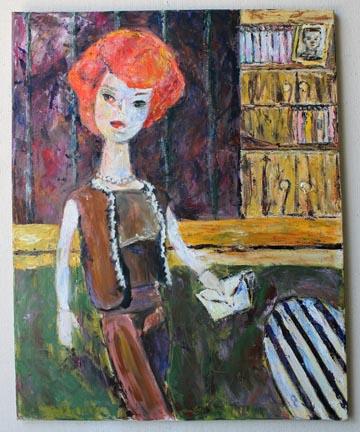 |
| Ann Oshita's "Barbie Expressionist I" as seen in Real People 2011 |
Slayton, MN Laura Veenhuis’ oversized stylized oil painting of a badass smoking cool wrinkled old lady named “Kitty.” On her website she says it’s the first of 7 in her “Tormented Women” series and “The theme relates to thoughts or feelings that challenge people everyday to be a good person or to lead a God pleasing life.” I thought it was a portrait of a snooty art collector surveying her surroundings! I believe g-d would like all of us, big cities and small towns et al, to appreciate art (make it, buy it, view it, critique it, whatever). Art is, after all, one of the pleasures of a reflective and engaged life no matter where in the world you are.
 |
| Installation view of Laura Veenhuis' "Kitty" in the Old Court House and former jail turned art center in Woodstock, IL |
Real People 2011 is held in the Old Court House Arts Center located at 101 N. Johnson, Woodstock, IL 60098. The exhibition is open August 4 - October 2. Gallery hours: Tues-Sat 11am-5pm, Sun 1-5pm. A reception will be held on August 27, 2011. Call 815-338-4525 for more information.
Sunday, August 7, 2011
48 hours in Stumptown: Portland Arts & Culture
I flew out to Portland, OR August 4-5th to participate on a panel discussion on mixed race Asian American (aka "hapa") art and identity organized by the Oregon Nikkei Legacy Center in conjunction with Kip Fulbeck's Part Asian/ 100% Hapa exhibition. I grew up outside of Seattle but since I left in 1991, I have never really had the chance to get to know Portland's arts and culture scene and truly capture the "Dream of the 90s."
With just 48 hours to explore, I came away with the impression that Portland is an organic foodie heaven with a crafty DIY arts culture and lot's of homeless advocates. Across the board, all the folks I met were very civically engaged. A new friend told me that she recently went to an unveiling ceremony for a public toilet that PHLUSH had been fighting for. If any of you have watched Portlandia, you know it's easy to make fun of (read the NY Time's review) but it's "weirdness" is also terribly endearing. I'm not sure how much fiscal sense this brand of liberalism all makes (they don't pay any sales tax...a totally shocking concept for me, coming from Chicago) but I enjoyed the book stores, good coffee, micro brews, local wines and knowing that the lamb burger with feta, dried apricots, pine nuts, roasted red onion, and spicy mint yogurt was from nearby Anderson Ranch. I didn't catch the name of the lamb or what his quality of life was but I'm sure if I asked the folks at Davis Street Tavern, they would have known.
With just 48 hours to explore, I came away with the impression that Portland is an organic foodie heaven with a crafty DIY arts culture and lot's of homeless advocates. Across the board, all the folks I met were very civically engaged. A new friend told me that she recently went to an unveiling ceremony for a public toilet that PHLUSH had been fighting for. If any of you have watched Portlandia, you know it's easy to make fun of (read the NY Time's review) but it's "weirdness" is also terribly endearing. I'm not sure how much fiscal sense this brand of liberalism all makes (they don't pay any sales tax...a totally shocking concept for me, coming from Chicago) but I enjoyed the book stores, good coffee, micro brews, local wines and knowing that the lamb burger with feta, dried apricots, pine nuts, roasted red onion, and spicy mint yogurt was from nearby Anderson Ranch. I didn't catch the name of the lamb or what his quality of life was but I'm sure if I asked the folks at Davis Street Tavern, they would have known.
 |
| Keep Portland Weird |
 |
| I visited the sprawling Nike campus in nearby unincorporated Beaverton, OR |
 |
| Oregon Nikkei Legacy Center |
 |
| Nicole Nathan, Director of Collections and Exhibits, and me at the Oregon Nikkei Legacy Center |
 |
| Kip Fulbeck's Part Asian/100% Hapa exhibition on view at the Oregon Nikkei Legacy Center through Dec. 31, 2011 |
 |
| Dr. Patti Duncan, Associate Professor of Women's Studies at Oregon State University, leading a discussion on mixed race Asian American identity and a tour of the Fulbeck exhibit for APANO (Asian Pacific American Network of Oregon). We all went out for karaoke and dumplings later that night at the Voice Box. They specialize in infused sake cocktails and are known for their bacon cheeseburger dumplings. |
 |
| Panel discussion moderated by Tim DuRoche with fellow Hapa and Critical Mixed Race Studies scholars/artists Emily Momohara and Dmae Roberts at the University of Oregon. |
 |
| It's a small world! In the audience at the University of Oregon was a classmate of on of my Auntie Nora from Hilo, HI - Pam Mattys. |
 |
| Oregon Nikkei Endowment Executive Director Mari Watanabe and artist Emily Momohara the morning after our panel discussion. |
 |
| I walked through the gallery district near Portland's Chinatown - I especially enjoyed viewing NY-based artist Ming Fay: Full Circle at Butters Gallery. Read Bob Hick's review in the Oregonian. The show was a mini retrospective of Fay's work and it was great to see his new work alongside the older pieces. He's making these colorful spray foam blobs that read like over ripe fruit with candy petals. |
 |
| Gallery owner David Butters looking at Ming Fay's work at Butters Gallery. |
 |
| Another top pick is Rick Bartow: Coyote's Road through August 27th at Froelick Gallery |
 |
| Rick Bartow's Bear Mother Dancing on Ignorance/Fear |
 |
| They were still installing this show but if you are in Portland later this month, be sure to check out Niki McClure: Cutting her Own Path, 1996-2011 opening on August 18, 2011 at the Museum of Contemporary Craft |
 |
| I didn't bother to stand in line for an hour at Voddoo Doughnuts. Every time I walked by there was a line out the door. Locals said that the best time to go is late at night. |
 |
| If you go to Portland, be sure to grab a cup of coffee at Stumptown Coffee. |
 |
| I asked the a barista at Stumptown where she suggested I go to lunch. She said they all eat at the food trucks but for something a little more upscale to try the new Little Bird Bistro. I was in a hurry to get to the airport so I just grabbed a soft roll, fried cod, celery root sandwich at the bar. |
Tuesday, July 26, 2011
Portland - Hapa and Critical Mixed Race Studies art panel
 |
| Kip Fulbeck Part Asian: 100% Hapa |
Held in conjunction with Kip Fulbeck's exhibition Part Asian: 100% Hapa at the Oregon Nikkei Endowment's Legacy Center.
University of Oregon in Portland
August 4, 2011 5:00-6:30pm
White Stag Block Room #142/144 (in the Old Town Historic Chinatown District)
70 NW Couch Street
Portland, OR 97209
For more information contact Nicole Nathan at 503-224-1458
http://www.oregonnikkei.org/exhibits.htm#exhibit

Hapa Soap Opera #5 (Joey Nakayama, Robert Karimi, Jef French)
Oil on canvas
72” x 48”
2003
View the complete series
Emily Hanako Momohara's new solo show, Islands, also opens this month in Ohio. Check it out in person or online:
 |
Island 4, 2011 Emily Hanako Momohara Emily Hanako Momohara: ISLANDS Reception: Friday August 12, 6-9pm Exhibition: August 12 – September 17, 2011 PAC Gallery, 2540 Woodburn Avenue, Cincinnati OH view images @ www.ehmomohara.com/Islands.html |
Wednesday, July 6, 2011
Seeing in color - art and mixed race
I was reviewing an Asian American marketing book (Many Cultures One Market by Robert Kumaki and Jack Moran) and getting my toenails painted dark fuchsia pink, just a few steps from blood red, at a neighborhood Vietnamese nail salon when I got a text that the New York Times article I've been waiting for had finally come out:
Pushing Boundaries, Mixed-Race Artists Gain Notice by Felicia Lee
The article highlights, amongst others, the recent Mixed Roots Film & Literary Festival, works by authors such as Heidi Durrow and Danzy Senna, filmmaker Jeff Chiba Stearn's "One Big Hapa Family" and artist Kip Fulbeck's traveling exhibition Part Asian/100% Hapa.
In the hours that followed, my inbox blew up with comments on mixed race (see the Critical Mixed Race Studies Facebook wall and the comments on the NY Times article). I kept thinking that what was missing here (both in the article and the online commentary) was a discussion of the artwork itself in terms of form and aesthetics and the different ways the various art forms (literature, film, spoken word, performance, visual arts etc.) change the terms of discussion on mixed race and how we might see (or read, or hear, or feel and experience) color.
Danzy Senna's You Are Free, a collection of short stories is a great summer read that let's you get lost in a world full of fascinatingly dysfunctional and complicated relationships. The female protagonists of these short stories are either biracial or in interracial relationships and, refreshingly, most of them are a bit older. These aren't the stories of a 20-somethings coming of age and searching for their individual identity. These are lives weathered by racial misreading and the messiness of desire and longing and they are defined against and beside their lovers, husbands, kids, parents, and friends.
Towards the end of the book, I tripped up and was knocked out of my "lost" state of summer fun reading with her story "Tryptich" in which Senna tells the same story (Cherries in Winter, Peaches in Winter, and Plums in Winter) of searching for fruit out of season/region set on a winter day in New Haven, CT the day after the main character's mother dies. At first I didn't like this suite. I resented it. It was disruptive and repetitive....the narrative arc and sentence structure stayed exactly the same in each story but what was switched out were the mix of racial and class details (the girls' music poster, the type of family dog, the type of car, where she shops, the profession of her father). Just as you think you know who is black, white, or biracial, the clues mess with you again. It wasn't until I was done with the book and few days passed that I kept thinking about these stories and how her use of structure made me think critically about the narratives rather than voyeuristically consuming them wholesale. This is what form can do. I think these stories also resonated for me, as a painter, because of the attentiveness to seeing in color.
"The fruit is piled neatly, identical apples and identical pears, not a mark on their waxy skins. There are plums too, imported from Ecuador at $3.99 a point. They are mostly hard, gold still showing under the purple. She fills a bag with six of the ripest she can find."
I could imagine that cool plum color and how it must look just as the sky begins to brighten on a winter morning. I was aware of the uncertainty of color, of its shifting nature, and how much our experience of seeing color relies on context and expectations.
I read the NY Time's and facebook wall posts while walking through the Museum of Contemporary Art Chicago with a fellow mixed race Japanese American friend to see the Mark Bradford Project and Pandora's Box: Joseph Cornell Unlock's the MCA Collection. The MCA had a few Paul Thek's up in their Cornell exhibition and this reminded me of the Paul Thek retrospective I saw last month at UCLA's Hammer Museum where I found myself unexpectedly blown away by his intentionally underwhelming low-craft paintings. I couldn't photograph in the gallery but there was this big sloppy pink painting of the Loch Ness monster. The monster was emerging from the water in some far away land and it was sketched out urgently in turquoise paint that reminded me of the 1940s. I went back three times to look at it. Color can leave you with out words and fill you with emotion and shock you into different places and times. I got an idea there that hopefully I'll be able to execute in the studio this week.
Another work that caught my attention at the Hammer that brings color into focus is Sam Durrant's lightbox - End of White Supremacy.
Look at this work and then read Steven F. Riley's opening remarks on white supremacy for a panel at the Mixed Roots festival - Don’t Pass on Context: The Importance of Academic Discourses in Contemporary Discussions on the Multiracial Experience.
Pushing Boundaries, Mixed-Race Artists Gain Notice by Felicia Lee
The article highlights, amongst others, the recent Mixed Roots Film & Literary Festival, works by authors such as Heidi Durrow and Danzy Senna, filmmaker Jeff Chiba Stearn's "One Big Hapa Family" and artist Kip Fulbeck's traveling exhibition Part Asian/100% Hapa.
In the hours that followed, my inbox blew up with comments on mixed race (see the Critical Mixed Race Studies Facebook wall and the comments on the NY Times article). I kept thinking that what was missing here (both in the article and the online commentary) was a discussion of the artwork itself in terms of form and aesthetics and the different ways the various art forms (literature, film, spoken word, performance, visual arts etc.) change the terms of discussion on mixed race and how we might see (or read, or hear, or feel and experience) color.
Danzy Senna's You Are Free, a collection of short stories is a great summer read that let's you get lost in a world full of fascinatingly dysfunctional and complicated relationships. The female protagonists of these short stories are either biracial or in interracial relationships and, refreshingly, most of them are a bit older. These aren't the stories of a 20-somethings coming of age and searching for their individual identity. These are lives weathered by racial misreading and the messiness of desire and longing and they are defined against and beside their lovers, husbands, kids, parents, and friends.
Towards the end of the book, I tripped up and was knocked out of my "lost" state of summer fun reading with her story "Tryptich" in which Senna tells the same story (Cherries in Winter, Peaches in Winter, and Plums in Winter) of searching for fruit out of season/region set on a winter day in New Haven, CT the day after the main character's mother dies. At first I didn't like this suite. I resented it. It was disruptive and repetitive....the narrative arc and sentence structure stayed exactly the same in each story but what was switched out were the mix of racial and class details (the girls' music poster, the type of family dog, the type of car, where she shops, the profession of her father). Just as you think you know who is black, white, or biracial, the clues mess with you again. It wasn't until I was done with the book and few days passed that I kept thinking about these stories and how her use of structure made me think critically about the narratives rather than voyeuristically consuming them wholesale. This is what form can do. I think these stories also resonated for me, as a painter, because of the attentiveness to seeing in color.
"The fruit is piled neatly, identical apples and identical pears, not a mark on their waxy skins. There are plums too, imported from Ecuador at $3.99 a point. They are mostly hard, gold still showing under the purple. She fills a bag with six of the ripest she can find."
I could imagine that cool plum color and how it must look just as the sky begins to brighten on a winter morning. I was aware of the uncertainty of color, of its shifting nature, and how much our experience of seeing color relies on context and expectations.
I read the NY Time's and facebook wall posts while walking through the Museum of Contemporary Art Chicago with a fellow mixed race Japanese American friend to see the Mark Bradford Project and Pandora's Box: Joseph Cornell Unlock's the MCA Collection. The MCA had a few Paul Thek's up in their Cornell exhibition and this reminded me of the Paul Thek retrospective I saw last month at UCLA's Hammer Museum where I found myself unexpectedly blown away by his intentionally underwhelming low-craft paintings. I couldn't photograph in the gallery but there was this big sloppy pink painting of the Loch Ness monster. The monster was emerging from the water in some far away land and it was sketched out urgently in turquoise paint that reminded me of the 1940s. I went back three times to look at it. Color can leave you with out words and fill you with emotion and shock you into different places and times. I got an idea there that hopefully I'll be able to execute in the studio this week.
 |
| Paul Thek: Diver, A Retrospective currently at the UCLA Hammer Museum through August 28, 2011 |
Another work that caught my attention at the Hammer that brings color into focus is Sam Durrant's lightbox - End of White Supremacy.
Look at this work and then read Steven F. Riley's opening remarks on white supremacy for a panel at the Mixed Roots festival - Don’t Pass on Context: The Importance of Academic Discourses in Contemporary Discussions on the Multiracial Experience.
 |
| Sam Durant. End White Supremacy, 2008. Electric sign with vinyl text, 96 x 136 in. Hammer Museum. |
Tuesday, June 14, 2011
Mixed Roots Recap

June 11-12, 2011
Japanese American National Museum
Los Angeles, CA
 | ||
| Mixed Messages- Mixed Race/ Interracial Represenation in TV, Film, & News Media workshop - Me, Jennifer Noble, Monique Fields, Heidi Durrow, Susan Straight |
Thoughts on Mainstream Media and Mixed Representation:
I was honored to be invited by Ebony journalist and Honeysmoke blogger Monique Fields to participate in a workshop on mainstream media. We were asked to look, in particular, at Ebony's first biracial issue in May 2011 and the New York Times' ongoing series on Race Remixed by Susan Saulny. Since our panel ran out of time and I didn't get to cover much from the notes I prepared, I thought I'd pass along my responses here. This was the original question Monique posed to us:
Q “what, if anything, it means that mainstream media are writing about multiracial Americans, whether there are any concerns about how mixed-race Americans are portrayed in mainstream media and what the panelists would suggest to reporters and editors as they continue to write about the mixed experience.”
My Short Answer: Susan Saulny’s NY Time’s “Race Remixed” series and the Ebony’s May coverage about biracial identity were very validating but they are just a start. We need more coverage like this but also in depth coverage that goes beyond the US Census and personal narratives that exemplify racial progress and pitfalls.
Growing up in the Sesame Street era of the 1970s and 80s I saw a lot of multicultural images in popular culture and the media but not interracial or explicitly mixed race. By the late 1990s, we had Tiger Woods and serial killer Andrew Cunanan squarely in the center of mainstream media coverage so there were images out there, besides the tragic mulatto stereotype, but now we were either racial saviors or demons.
I think this vacuum of representation is one of the motivating factors in me wanting to create artworks, classes, conferences etc. that reflect not only my own story but a larger narrative and history of what it means to be mixed race in the US and beyond.
Growing up in the Sesame Street era of the 1970s and 80s I saw a lot of multicultural images in popular culture and the media but not interracial or explicitly mixed race. By the late 1990s, we had Tiger Woods and serial killer Andrew Cunanan squarely in the center of mainstream media coverage so there were images out there, besides the tragic mulatto stereotype, but now we were either racial saviors or demons.
I think this vacuum of representation is one of the motivating factors in me wanting to create artworks, classes, conferences etc. that reflect not only my own story but a larger narrative and history of what it means to be mixed race in the US and beyond.
And my long answers....
Types of Media: Before I could answer Monique's question to us, I had to think about my relationship to “mainstream media.” I'm certainly not an expert on media but I'm a consumer like everybody else. I consume mostly mainstream “prestige media” like NPR, CNN, and the New York Times or I look to mainstream media for mindless entertainment: cooking shows on FoodNetwork, silly animal/reality TV shows like "Hogs gone Wild" on Discovery Channel, or Sponge Bob....I should preface this by the fact that my 6 year-old influences a lot of what I watch. But Anderson Cooper and Mr. Crabs isn’t where I look for news about mixed race – it’s really more through social networking – word of mouth/sharing articles with like-minded folks either through non-profit orgs, academic networks or social networks, blogs, podcasts. Like a lot of people, I’m a niche consumer and I probably know a lot about a very narrow topic. If you really want mixed race news, go to Steven F. Riley's blog www.mixedracestudies.org or Heidi Durrow and Fanshen Cox' podcast mixedchickschat or listen in on the panels or watch videos from CMRS 2010 on ITunesU.
Even as I say this, I'm reminded of a paper that I heard Kent Ono deliver at the Association for Asian American Studies conference on the invisibility of mixed race on TV and how we are both everywhere and yet remain invisible. He was analyzing the reality TV show Jon and Kate plus 8. Also, remember Mary Beltran's keynote at Critical Mixed Race Studies 2010 "Everywhere and Nowhere"?
Usefulness of Media Coverage: Mainstream media is a powerful form of external validation. For example, the NY Times article on the increase of multiracials who are just now entering college, "Black? White? Asian? More Young Americans Choose All of the Above", was useful to me in a concrete way this past month as I was able to advocate in my University to include multiracials in a draft of a strategic plan for diversity that we are currently finalizing.
I also found the demographic shift of multiracials in the South, "Black and White and Married in the Deep South", informative and this will help guide my work on the board of MAVIN for a community mapping project we are working on with Census 2010 data where we plan to look at key cities across the US to analyze where multiracial populations exist and are growing and what and where existing resources are. We are in the process of assessing which southern city to pick.
Q So what would I suggest to reporters and editors as they continue to write about the mixed experience?
I really appreciate is how papers such as the New York Times have been tapping folks that we know and respect in the movement such as Louie Gong from MAVIN and 8th Generation as experts to consult with during national racial flash points such as when back in October 2010 a Republican candidate for the Senate in Nevada, Sharon Angle, told a group of Latino students that she did not know if they were all Latino because “some of you look a little more Asian to me.” I hope we can see more of our community, academic and cultural leaders tapped as experts on a routine basis....there's always going to be a mixed point of view or lens to issues and they don't always have to be about race.
Further Research - Books I'd like to recommend on mixed race media:
Making Multiracials: State, Family, and Market in the Redrawing of the Color Line by Kymberly McClain Da Costa (Stanford, 2007)
Making Multiracials: State, Family, and Market in the Redrawing of the Color Line by Kymberly McClain Da Costa (Stanford, 2007)
Mixed Race Hollywood by Mary Beltran and Camilla Fojas (NYU Press, 2008)
Souls of Mixed Folks: Race, Politics, and Aesthetics in the New Millennium by Michele Elam (Stanford, 2011)
Souls of Mixed Folks: Race, Politics, and Aesthetics in the New Millennium by Michele Elam (Stanford, 2011)
I’ve also been thinking about what needs to be done in terms of cultural work within the mixed race movement. This may or may not relate to mainstream media but I just want to put it out here what I'm thinking about for my own work:
- building sustainability and professionalization – by this I mean building fund raising networks, creating opportunities for publications and venues for exhibitions and shows. It seems like a lot of times we are not only creating the cultural programming but having to build the entire delivery system as well. You can only do that for so long without getting burned out.
- Go beyond US racial politics and build international networks of folks working on mixed race cultural production. For example, I want to connect more with mixed Okinawan artists in the diaspora and I'm looking forward to showing with fellow mixed Okinawan American artist Emily Momohara in the near future and reading blogs such as Grits and Sushi by Mitzi Uehara-Carter. I’m also curious to learn more about Australia’s "lost (or rather stolen) generation" that is coming of age and reclaiming their hybrid indigenous roots. At a recent symposium on the Future of Asian Art that I participated in at NYU, Dean Chan talked about the work of Brisbane indigenous artist Vernon Ah Kee (who is also of Chinese descent). Ah Kee does these big charcoal portrait drawings based on anthropological photos taken by Norman Tinsdale, at the behest of the Australian government, of what they thought was going to be a dying race. These images include Ah Kee’s own grandparents. Ah Kee states in a video clip on YouTube, “There should be a representation in art of Aboriginal people that is full of depth, sophistry, complexity, and sadness, and sorrow. All these things that everybody else is allowed to be but black fellows aren’t.” I think the same thing pertains to images of mixed race people in art.
- I want to use a mixed lens to drill down into Asian American art history– A colleague at DePaul, Scott Paeth, was talking to me yesterday about being a fox vs a hedgehog with research - covering vast territory or burrowing down. My tendency is to be a fox but I think it's time in the mixed race movement and in Asian American art to be a hedgehog. In teaching a class on Mixed Race Art and Identity since 2009 at DePaul, I realized that there was a lot of work that could be done on just looking at one aspect of this vast and emerging topic so for the past few years, I’ve been working with Wei Ming Dariotis, Assistant Professor of Asian American Studies San Francisco State University, on a multi-author volume and traveling contemporary art exhibition called War Baby/Love Child: Mixed Race Asian American Art which examines how mixed race Asians are addressing and negotiating their identities through their art. The project also seeks to begin to document the complex historical forces that have defined the hapa experience, namely US Wars in Asia and the legacy of the Civil Rights era. Our experiences as hapas are not necessarily singularly unique. There are patterns and currents in our communal history
Mixed Roots Festival Recap:
After the excitement of the 2010 Critical Mixed Race Studies conference in Chicago that I co-organized back in November, I was curious to see in person what's been happening this year across the US in the mixed race movement. I heard the buzz but missed going to the UC Berkeley Institute of East Asian Studies Hapa Japan Conference and Harvard's Half-Asian People's Association So...What Are you, Anyway?
What is unique about Mixed Roots is that they bring together authors, filmmakers, performers, artists, community, general public, and academics from multiple backgrounds. For the most part I saw representation from the biracial community and hapa folks but there was some representation from multiracial Latino and Native communities as well. I'd like to see more variety in representation but there are historical and colonial reasons why biracials and mixed Asians dominate this discourse.
Steven F. Riley's introduction to his workshop with G. Reginald Daniel, "Don't Pass on Context", gave me a lot to think about. Riley pointed out three main areas that we have been bypassing in the mixed race movement: 1) The persistence of inequality 2) Race is a social construct 3) Historical context. Within this, he had a considered critique of the construction of Loving vs. Virginia being a starting point for mixed activism and representation and the myth of the biracial baby boom. He also talked about white supremacy and how this was the cornerstone for anti-miscegenation laws and how miscegenation laws created race in this country. As he closed he said, "We are not becoming a multiracial society, we are and have been so for centuries." Also, I should point out the Mr. Riley probably knows more about any mixed anything than anyone else in the room. And what does he read? He gave a shout out to Nicole Nfonoyim's blog: http://mixedreamers.blogspot.com/
 | |
| Don't Pass on Context: The Importance of Academic Discourses in Contemporary Discussion on the Multiracial Experience - Steven F. Riley is pictured to the left and G. Reginald Daniel to the right |
| Coming to Jesus - I was talking to a friend after the festival and they said they ran into a student who had traveled across the country from some small town in the middle of nowhere to come to Mixed Roots and that she, like so many others, had her "come to Jesus moment." As I work in critical mixed race and the deeper I get into academia and art, it's easy to become cynical and view the act of using documentary and straight narrative to tell your story as simplistic...too easy. I'm all for abstraction and experimental forms but I have to remember where I came from and how powerful and important it was developmentally to be able to see myself in others...to know that I wasn't alone. And I came from a loving and accepting family and community (albeit rural and mostly "white" and we did have one cross burning and my childhood is not without enduring a few racial slurs and a shot gun or two). I can only imagine what it must be like for others who have faced rejection and prejudice and isolation. Even today, I feel down right ecstatic about having an expanding network of friends who I consider kin. I may have converted to Judaism but I still have "come to Jesus" moments myself but I wonder what happens the morning after? I'm also reminded of Frank Chin's critique of the autobiographical impulse in early Asian American literature and the parallels to the Christian concept of the confession and all the baggage that comes with that. This can't just be about self and identity and recognition? The analogy to getting saved is like coming out. It's a relief after years of passing, covering, or being hyper visible or invisible. I know folks have been working on multiracial issues communally in the US for 20-30 years (e.g. MASC and Biracial Family Network) but as part of the 2nd generation of activists post-2000 Census, what are our next challenges? |
 |
| Me with UCLA students and friends |
| Why does it matter for us to come together as a community? Maybe Athena Mari Asklipiadis from Mixed Marrow has the answer? Is it about access and improving quality of health care? If race is a social construct, what does mixed race mean in terms of medicine? Mixed Marrow began in 2009 in response for the need for a multiethnic-specific outreach due to the lack of public knowledge and registered donors. Mixed Marrow is dedicated to finding bone marrow and blood cell donors to patients of multiethnic descent. Our outreach concentrates on this minority due to the desperate need for registered donors as well as the lack of public knowledge regarding this topic. We are dedicated to educating the multiethnic community through multimedia tools such as internet, video, and photography and hosting drives to register donors.  |
 |
| Me with multigenerational members of MASC - Farzana Nayani and son, Nancy Brown, Jennifer Noble, Thomas Lopez |
 | |
| Paul Spickard and MASC founder Nancy Brown |
Paul Spickard was one of the 2011 Loving Prize Honorees for his pioneering scholarship "on issues concerning the Mixed experience." |
 |
| Toasting Mixed Roots 2011 |
 |
| Festival founders Fanshen Cox and Heidi Durrow |
 |
| Opening night reception |
 |
| Kip Fulbeck honoring Paul Spickard or rather telling tales out of school! |
 |
| Kip and Paul hugging |
 | |
| Filmmakers Jessica Chen Drammeh and Marcelitte Failla |
| The heart of the festival, of course, are the films and readings. I never get tired of seeing Jessica Chen Drammeh's film Anomaly. I was struck by how her film not only tells our story but how it has been an instrument in building community in and of itself. She took a unique approach to production - she would shoot a little and then do a work in progress screening and host a fundraiser and then with that money, shoot a little more and repeat the process. What ended up happening is that in the many years it is taking to finish this film, she both captured individual narratives over time but also the emergence of the 2.0 mixed race movement. I only got to see the Mixed Roots 2011 Short Film screenings (which also included Marcelitte Failla's Uncovering Color and Kamala Todd's Cedar & Bamboo) but I heard quite a bit of buzz around Victoria Mahoney's Yelling at the Sky and I'd seen Jeff Chiba Stearns One Big Hapa Family at the Asian American Film Festival in Chicago earlier this year (my daughter decided to identify as "quapa" after seeing his movie). It's an inspiring and accessible film that covers Canadian mixed Asian history and raises critical questions as to who and why we marry others outside of our racial group. His film is spot on for many of the issues I see in my own Japanese American community and experience (out marriage, assimilation into whiteness, finding your own roots, legacy of WWII and internment and internalized racism, changing what it means to be Japanese American or Canadian today, seeing Japanese identity as expansive rather than disappearing etc.) |
 |
| Danzy Senna reading from her new book of short stories - You are Free |
 | |
| Sarah Culberson, author of A Princess Found, telling her story |
There was a lot of talent and heart felt stories on stage. Musician/story teller Jason Luckett stole the Unplugged special event for me. He's got an amazing and confident yet slightly goofy stage presence and I kept thinking he sounded a little like Jack Johnson. The 2nd Story performers were all on point. I have to give a big shout out to Kimberlee Soo for her hilarious story of coming of age as a transracial Asian adoptee with a blond bombshell big sister and to Khanisha Foster for her powerful story of growing up as a light skinned daughter of a very black Black Panther and what it was like as an adult to teach the story of Martin Luther King to a group of elementary students who saw her as Latina.
It's almost impossible to say what was best about Mixed Roots 2011 but if I had to pick, I'd say Danzy Senna and Sarah Culberson. Danzy because she's just a damn good writer. I remember not being able to put down her novel Caucasia. She read 8 pages from "What's the Matter with Helga and Dave?" from her new book of short stories, You are Free, and I was hooked again! So form really does matter after all. While I may have my "come to Jesus" moment at conferences and festivals, what's going to stay with me as deep inspiration is those stories, movies, and music that is of quality, that is complex, that is innovative, that is unique. Form matters. Sarah Culberson's story just had us all in tears. She grew up as a confused biracial girl in a white family in West Virginia and as an adult, hired a private investigator to track down her birth parents. Her mother had died 11 years earlier but she did end up finding her father and learning she was actually the daughter of an African chief! It's a powerful (and funny) story but what she leaves us with is not just a feel good story with an amazing true life fairy tale ending but a provocation to action. Sarah's father is a chief in Sierra Leone and she is working to help rebuild her father's community, which was torn apart from 11 years of civil war. Through her work with the Kposowa Foundation Sarah is raising funds to "rebuild a boarding school, provide drinking water, provide economically sustainable opportunities, and improve the general quality of life for the people of Sierra, Leone, West Africa." To learn more about her story, watch Sarah Culberson's interview on CNN.
Mixed Roots Midwest anyone?
postscript to my post from earlier this morning
.....An artist friend of mine that I met in Chicago, Gwenn-Aël LYNN, just brought a project of his to my attention and I think he raises some challenging points to think about in terms of the concept of roots. Gwenn wrote to me about his project Roots...[a speaking garden] that, "it's a project I did in Paris this past fall: it investigates the metaphor of roots as pertaining to one's origins: how relevant is that metaphor when one identifies with several identities, with being uprooted, replanted? or as having no roots at all? What happens in the face of migration on a global scale?"
Monday, May 30, 2011
Woman Made Gallery - Transnational Artistic Collaboration: Shelly Jyoti and Laura Kina
Saturday, June 18, 2011 / 2 to 4 p.m.
Woman Made Gallery
685 N. Milwaukee, Chicago, IL 60642
312-738-0400 / gallery@womanmade.org
Woman Made Gallery
685 N. Milwaukee, Chicago, IL 60642
312-738-0400 / gallery@womanmade.org
Join us for a conversation with Woman Made artists Shelly Jyoti, from Vadodara, India, and Chicago-based Laura Kina about their collaborative exhibition 'Indigo' which was featured in three venues in India in 2009-2010 (Red Earth Gallery in Vadodara, India Habitat Centre in New Delhi, Nehru Art Centre in Mumbai) and is currently touring the US in 2011 (ArtXchange Gallery in Seattle and Diana Lowenstein Fine Arts in Miami). Refreshments will be served.

Japanese American Museum - Mixed Roots Panel - Mixed Messages
MIXED ROOTS FILM & LITERARY FESTIVAL
Saturday, June 11 11:00 am-12:00pm
Japanese American National Museum
369 E. 1st St.
Los Angeles, CA 90012
Workshop location - National Center for Democracy, Democracy Lab
http://www.mxroots.org/workshops-2011
Mixed Messages – Mixed Race / Interracial representation in TV & Film & News Media
Moderator: Monique Fields
Panelists: Jennifer Noble, Thomas Lopez, Laurel Hoa, Laura Kina, Susan Straight, Heidi Durrow
Multiracial Americans of Southern California (MASC) and journalists and artist activists will discuss mixed race representation in reality TV and in the news media and its impact on the community. Can monoracials tell our stories? Do we want our “dirty laundry” aired? And what is the impact and import of special reports on the Mixed experience in Ebony Magazine and the New York Times? Is there a role we can play with media organizations to get our stories told to the mainstream with sensitivity, without appearing “tragic”? How can we advocate for mixed race and interracial couple stories in the creation of TV sitcom/reality/drama content? Panelists discuss tips and tools for how to create and ensure non-exploitative representation.
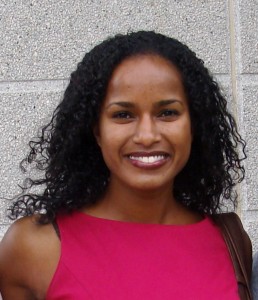
Jennifer Noble, PhD, is the current vice president of MASC and a full-time professor of Psychology at Pasadena City College. She also provides psychotherapy for children/adolescents and their families at the Reiss Davis Child Study Center. Jennifer is a past president of MASC, current board member and a part of MASC since 1999.
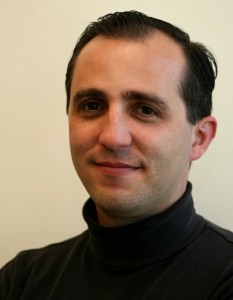
Thomas Lopez is the Parent Liaison and Treasurer for MASC. He is the leader of the MASC children’s playgroup, a past president and a member for over 15 yrs. Thomas is a mechanical engineer working in the medical devices industry. He is native to SoCal with parents from Mexican American and German-Polish roots.
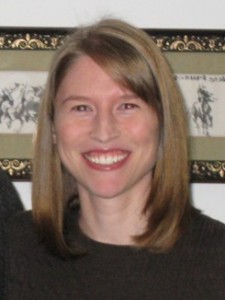
Laurel Hoa, PhD, received her PhD in Development with a specialization in Developmental Sciences from the University of Maryland, College Park. Her dissertation was on identity development in individuals of Asian/European descent. She is interested in helping parents foster positive identities in their mixed race children. She and her Chinese-American husband recently had their first child.
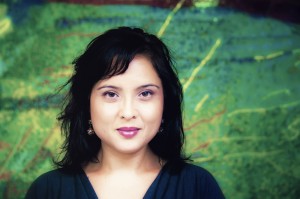
Laura Kina is an artist and Associate Professor of Art, Media, & Design and co-organizer of the inaugural 2010 Critical Mixed Race Studies conference at DePaul University. She is a board member of MAVIN and is working to launch a journal on Critical Mixed Race Studies through UC Santa Barbara.
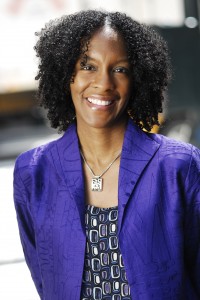
Monique Fields is a journalist, teacher and blogger. She launched Honeysmoke.com, and it draws 10,000 unique visitors every month. Her essays about interracial marriage and raising biracial children have appeared on NPR.org, Literarymama.com, the St. Petersburg Times, and theroot.com
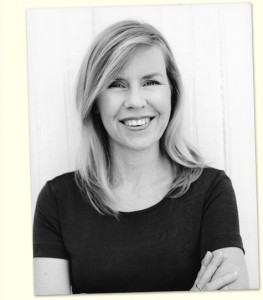
Susan Straight was born in Riverside and still lives there with her family. (She can actually see the hospital from her kitchen window, which her daughters find kind of pathetic; most days, she walks the dog past the classroom where she wrote her first short story at 16, at Riverside City College, which they find even more sad.) She has published seven novels and one middle-grade reader. Highwire Moon was a finalist for the National Book Award in 2001; A Million Nightingales was a finalist for the Los Angeles Times Book Prize in 2006. She was awarded a Guggenheim Fellowship to work on Highwire Moon, and a Lannan Prize was an immense help when working on Take One Candle Light a Room.
Co-Founder/Co-Producer Mixed Roots Film & Literary Festival
Heidi W. Durrow (left) is a graduate of Stanford University, Columbia University’s Graduate School of Journalism, and Yale Law School. Heidi has worked as a corporate litigator at Cravath, Swaine & Moore, and as a Life Skills trainer for the National Football League and National Basketball Association. She blogs at Light-skinned-ed Girl and is the co-producer and co-host of the award-winning podcast, Mixed Chicks Chat. She is an occasional essay contributor to National Public Radio. Heidi is the winner of writer Barbara Kingsolver’s Bellwether Prize for Literature of Social Change.
Heidi’s debut novel, The Girl Who Fell From the Sky (Algonquin Books), about a young biracial girl’s coming-of-age, is currently a New York Times Bestseller . It was named as one of the Best Novels of 2010 by the Washington Post and a Top 10 Book of 2010 by The Oregonian. Ebony Magazine recently named Heidi as one of its Power 100 Leaders of 2010 along with writers Edwidge Danticat, Malcolm Gladwell and Ntozake Shange, and was nominated for an NAACP Image Award. www.heidiwdurrow.com
Saturday, June 11 11:00 am-12:00pm
Japanese American National Museum
369 E. 1st St.
Los Angeles, CA 90012
Workshop location - National Center for Democracy, Democracy Lab
http://www.mxroots.org/workshops-2011
Mixed Messages – Mixed Race / Interracial representation in TV & Film & News Media
Moderator: Monique Fields
Panelists: Jennifer Noble, Thomas Lopez, Laurel Hoa, Laura Kina, Susan Straight, Heidi Durrow
Multiracial Americans of Southern California (MASC) and journalists and artist activists will discuss mixed race representation in reality TV and in the news media and its impact on the community. Can monoracials tell our stories? Do we want our “dirty laundry” aired? And what is the impact and import of special reports on the Mixed experience in Ebony Magazine and the New York Times? Is there a role we can play with media organizations to get our stories told to the mainstream with sensitivity, without appearing “tragic”? How can we advocate for mixed race and interracial couple stories in the creation of TV sitcom/reality/drama content? Panelists discuss tips and tools for how to create and ensure non-exploitative representation.

Jennifer Noble, PhD, is the current vice president of MASC and a full-time professor of Psychology at Pasadena City College. She also provides psychotherapy for children/adolescents and their families at the Reiss Davis Child Study Center. Jennifer is a past president of MASC, current board member and a part of MASC since 1999.

Thomas Lopez is the Parent Liaison and Treasurer for MASC. He is the leader of the MASC children’s playgroup, a past president and a member for over 15 yrs. Thomas is a mechanical engineer working in the medical devices industry. He is native to SoCal with parents from Mexican American and German-Polish roots.

Laurel Hoa, PhD, received her PhD in Development with a specialization in Developmental Sciences from the University of Maryland, College Park. Her dissertation was on identity development in individuals of Asian/European descent. She is interested in helping parents foster positive identities in their mixed race children. She and her Chinese-American husband recently had their first child.

Laura Kina is an artist and Associate Professor of Art, Media, & Design and co-organizer of the inaugural 2010 Critical Mixed Race Studies conference at DePaul University. She is a board member of MAVIN and is working to launch a journal on Critical Mixed Race Studies through UC Santa Barbara.
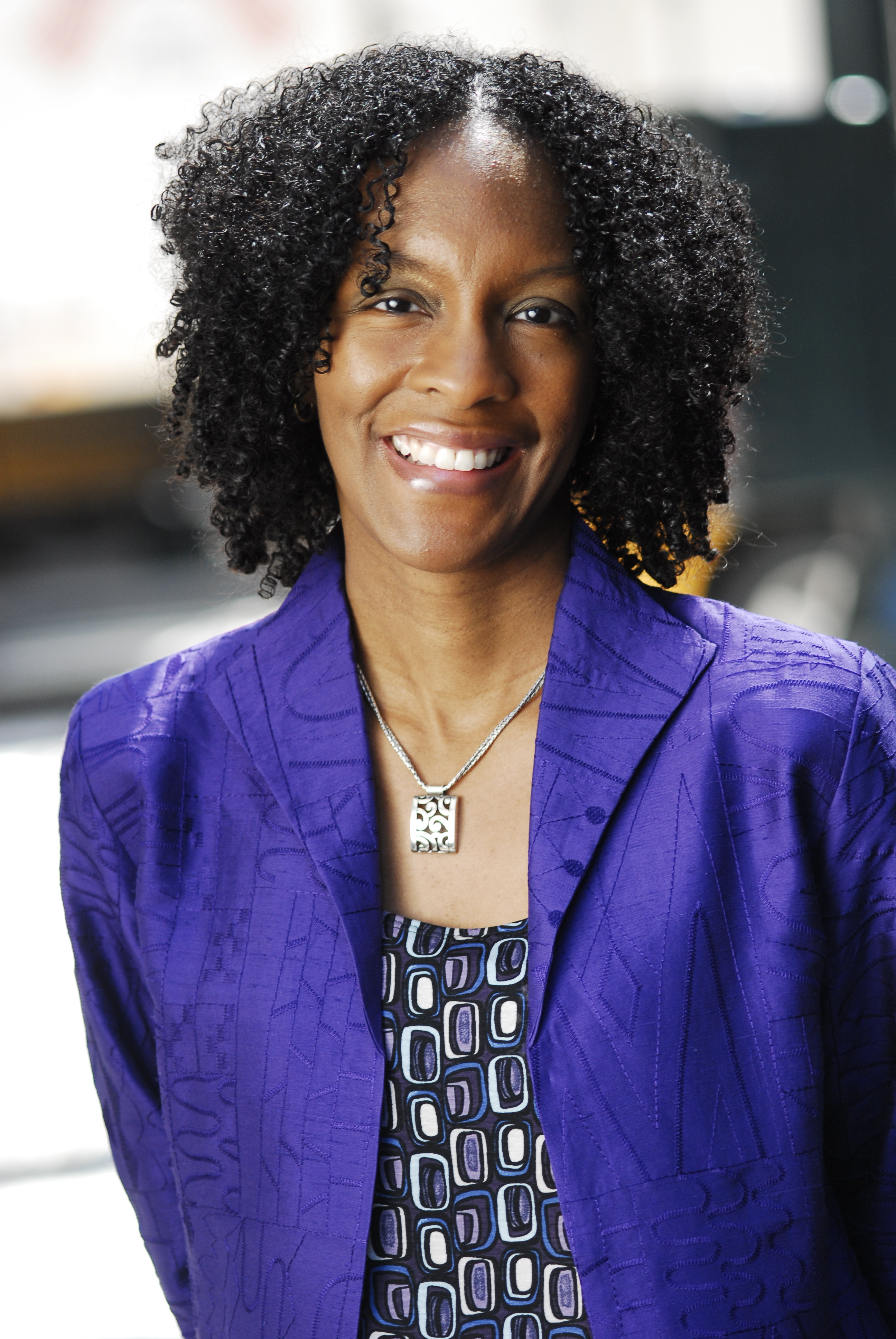
Monique Fields is a journalist, teacher and blogger. She launched Honeysmoke.com, and it draws 10,000 unique visitors every month. Her essays about interracial marriage and raising biracial children have appeared on NPR.org, Literarymama.com, the St. Petersburg Times, and theroot.com

Susan Straight was born in Riverside and still lives there with her family. (She can actually see the hospital from her kitchen window, which her daughters find kind of pathetic; most days, she walks the dog past the classroom where she wrote her first short story at 16, at Riverside City College, which they find even more sad.) She has published seven novels and one middle-grade reader. Highwire Moon was a finalist for the National Book Award in 2001; A Million Nightingales was a finalist for the Los Angeles Times Book Prize in 2006. She was awarded a Guggenheim Fellowship to work on Highwire Moon, and a Lannan Prize was an immense help when working on Take One Candle Light a Room.

Heidi W. Durrow (pictured to the left)
Co-Founder/Co-Producer Mixed Roots Film & Literary FestivalHeidi W. Durrow (left) is a graduate of Stanford University, Columbia University’s Graduate School of Journalism, and Yale Law School. Heidi has worked as a corporate litigator at Cravath, Swaine & Moore, and as a Life Skills trainer for the National Football League and National Basketball Association. She blogs at Light-skinned-ed Girl and is the co-producer and co-host of the award-winning podcast, Mixed Chicks Chat. She is an occasional essay contributor to National Public Radio. Heidi is the winner of writer Barbara Kingsolver’s Bellwether Prize for Literature of Social Change.
Heidi’s debut novel, The Girl Who Fell From the Sky (Algonquin Books), about a young biracial girl’s coming-of-age, is currently a New York Times Bestseller . It was named as one of the Best Novels of 2010 by the Washington Post and a Top 10 Book of 2010 by The Oregonian. Ebony Magazine recently named Heidi as one of its Power 100 Leaders of 2010 along with writers Edwidge Danticat, Malcolm Gladwell and Ntozake Shange, and was nominated for an NAACP Image Award. www.heidiwdurrow.com
Subscribe to:
Comments (Atom)