Reposted from the University of Washington Press blog:
http://uwpressblog.com/2015/01/21/talking-about-critical-mixed-race-studies-in-the-wake-of-ferguson/
In this guest post, Laura Kina, coeditor of War Baby / Love Child: Mixed Race Asian American Art,
discusses the emerging discipline of mixed race studies and what it can
contribute to ongoing dialogues surrounding race, police brutality, and
social justice in the wake of Ferguson.
Since the deaths this past summer of two unarmed black men, Michael
Brown Jr. in Ferguson, Missouri and Eric Garner in Staten Island, New
York by white police officers, our nation has been embroiled in
discussions of police brutality and racial profiling. The social unrest
and racial tensions of our current moment are a stark contrast to the
congratulatory “post-racial” moment in 2008 with the election of
President Barack Obama–the first black “biracial” president. Recent
racial tensions also present stark contrast to the celebration of the
multiracial “melting pot” that America celebrated following the 2000 US
Census, which allowed individuals to self-identify as more than one race
for the first time.

Those
earlier, problematic readings of race—as something to either get beyond
or as something new and worthy of celebration—coupled with the dearth
of history and representations of mixed race Asian American lives
inspired my coauthor Wei Ming Dariotis and I to publish
War Baby/Love Child: Mixed Race Asian American Art
(University of Washington Press, 2013). Along with my DePaul colleague
Camilla Fojas, we also set out to challenge these myths and establish a
scholarly field of
Critical Mixed Race Studies.
In November 2014, DePaul University hosted an international conference—“
Global Mixed Race,” the 3rd biennial Critical Mixed Race Studies conference
in Chicago. More than 600 people attended, including scholars, artists,
performers, filmmakers, activists, and students from across the United
States as well as Canada, United Kingdom, Japan, and Australia. The
conference featured two keynote speakers from Ireland: Rebecca Chiyoko
King-O’Riain, author of
Pure Beauty: Judging Race in Japanese American Beauty Pageants and coeditor of
Global Mixed Race; and Zélie Asava, author of
Black Irish Onscreen: Representing Black and Mixed Race Identities in Irish Film and TV. Through our partnership with the nonprofit organization
Mixed Roots Stories
we presented live performances and film screenings across the
conference. This central inclusion of the arts prioritizes the
importance of storytelling, the rootedness in the texture and affect of
lived experiences, the world of imagination, and visions of alternative
realities.
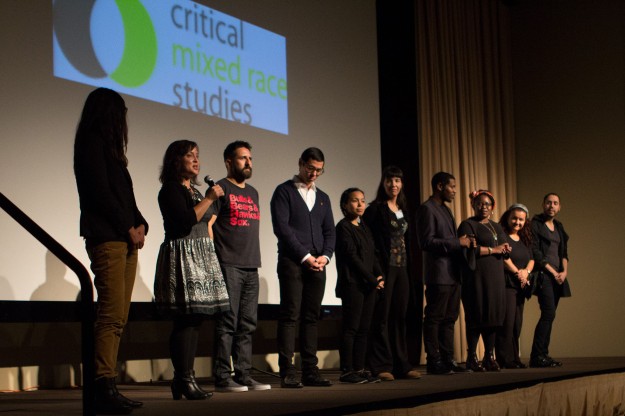
Closing
remarks at Mixed Roots Stories Live Performance at the November 2014
Critical Mixed Race Studies conference. Photo by Ken Tanabe.
Critical Mixed Race Studies is about recognizing the totality of
one’s heritage—seeing race and systems of racism in the particular
context of mixed race and talking about what this means for our lives
and communities today, what it has meant historically, and what we might
envision our futures to be like, and what we can do now to help in
anti-racist struggles across many different communities. It reflects a
turn to comparative racialization that challenges discrete categories of
race and it is inherently tied to colonial and imperial histories,
giving it a transnational and global focus that displaces the United
States from the center of critical analysis.
The mixing of races is the result of various kinds of migration, both
forced and at will, and it is the outcome of imperial expansion
throughout the ages. Moreover, the idea of mixed race is not based on
discrete racial categories or some cultural or ethnic similarities—e.g.,
food, customs, or language—or geographical location. Rather mixed race
is a way of seeing that enables an examination of the comparative
processes of racialization without resorting to any single defined group
identity or place.
Our 2014 theme, “Global Mixed Race,” recognized this widening scope
of critical mixed race studies in its comparative, transnational, and
global dimensions. We are attentive to the persistence of racialized
violence and the troubled history of racism in the US and the world as
we explore issues of multiracial and mixed intimacies and contact along
with the possibilities of global anti-racist political alliances among
multiracial communities and their allies.
As the urgency of how much black lives matter fades from the
headlines, it’s important for us to keep an intersectional focus on
these issues. As Critical Mixed Race Studies and Mixed Roots Stories and
many other multiracial community organizations collectively stated in
November 2014 in support of the family of Michael Brown Jr.: “We are
connected to these events and stand in solidarity with the many
individuals and communities that have been harmed by the legacies of
white supremacy, privilege, and racism. As community organizers,
scholars, activists, writers, and artists, we remain resolute in
dismantling racism through our work and actions.”
—
Laura Kina is an artist and Vincent de Paul professor of Art, Media, & Design at DePaul University. She is the coeditor, along with
Wei Ming Dariotis, of
War Baby/Love Child: Mixed Race Asian American Art. Her solo exhibition, “Blue Hawaiʻi,” is on view from January 27 through March 3, 2015 at the
Harold B. Lemmerman Gallery at New Jersey City University. Visit
Kina’s website for more information.
Watch Critical Mixed Race Studies and Mixed Roots Stories videos from the November 2014 conference:
Critical Mixed Race Studies keynote address:
Rebecca Chiyoko King-O’Riain,
“Mixed Race, Transconnectivity, and the Global Imagination”
Mixed Roots Stories keynote address :
Zélie Asava, “The Black Irish Onscreen”
Mixed Roots Stories live performances